
and America Helped Build the Competition
Tide Bandits Deep Dive
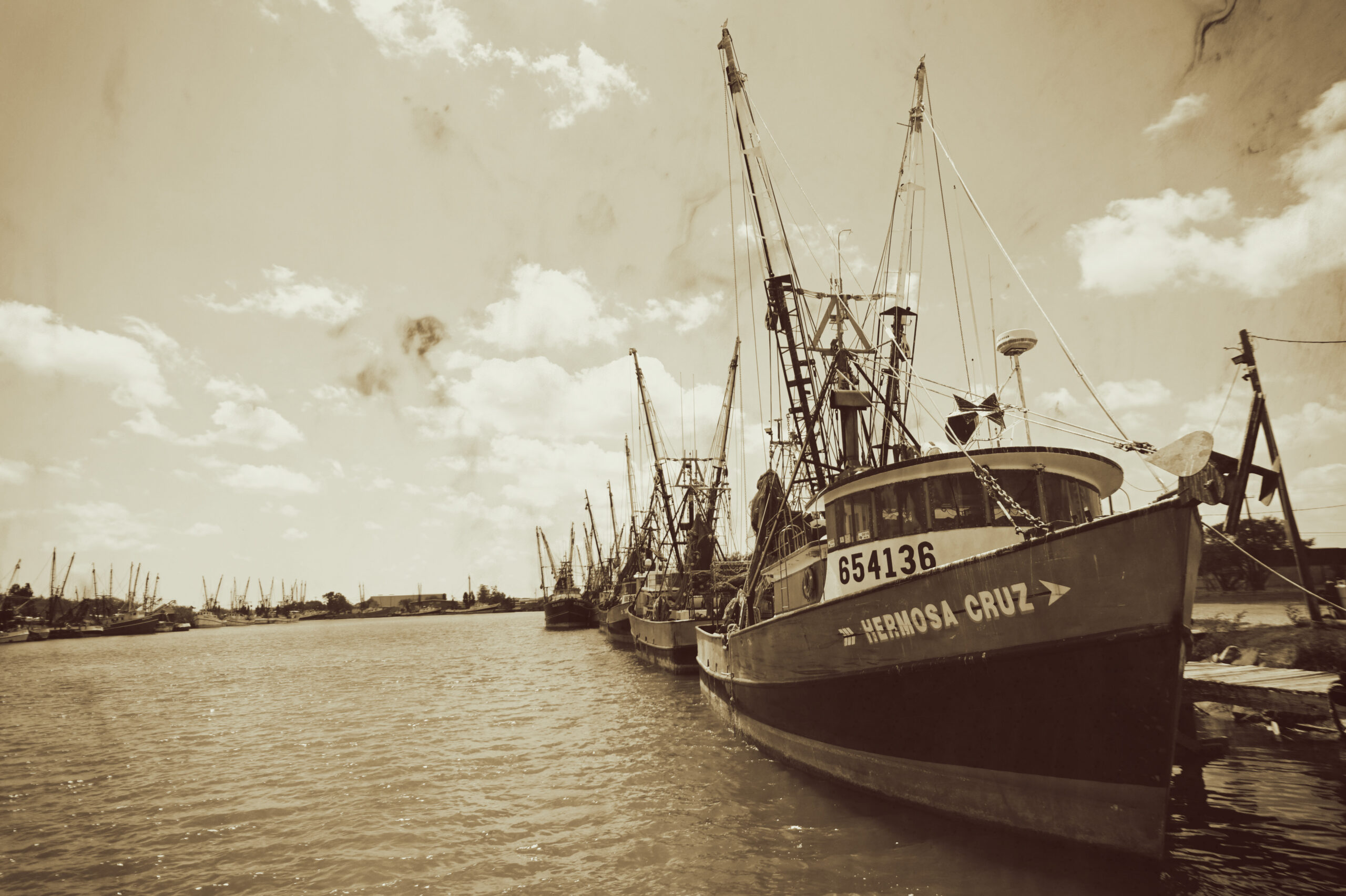
Along the Gulf Coast, shrimp boats are tied to docks not because the shrimp are gone, but because the math no longer works.
That distinction matters. This is not primarily a biological collapse. NOAA says Gulf shrimp populations remain stable and are not undergoing overfishing. What is collapsing is the American fleet built to catch them: the boats, crews, docks, processors and family businesses that have supplied wild Gulf shrimp for generations.
The numbers are brutal. According to a 2026 NOAA Fisheries economic snapshot, Gulf shrimp revenue fell from $489 million in 2021 to $221 million in 2023—a loss of $268 million in two years. The number of active shrimp vessels dropped 19 percent over that same period, and the industry lost an estimated 1,200 jobs.
This did not happen because Americans stopped eating shrimp. U.S. shrimp consumption more than quadrupled between 1984 and 2023. The problem is where that shrimp now comes from, what it costs to produce, and whether an American boat can survive while competing against a global aquaculture machine.
By 2023, Gulf-harvested shrimp accounted for only 4.5 percent of the U.S. market, down from 28.7 percent in 1984. Adjusted for inflation, the average price of Gulf shrimp fell from more than $6 per pound in the 1980s to less than $2 in 2023.
At the same time, fuel, labor, maintenance, insurance, ice, gear and dock costs kept rising.
That is the crisis in one sentence: American shrimpers are selling into a depressed global market while paying American operating costs.
A Flood of Cheap Farm-Raised Imports
Shrimp is now America’s most-consumed seafood, but most of that demand is supplied by imported product. Modern aquaculture can raise enormous volumes of warmwater shrimp year-round, at scale, in countries with lower labor, land and regulatory costs.
Imported shrimp is not automatically unsafe, unethical or illegally traded. Plenty of foreign farms operate legally, and aquaculture has made shrimp inexpensive and widely available. But the market has become so import-dependent that domestic boats have little power to set a price that reflects their actual cost of fishing.
The U.S. International Trade Commission reported that imports from India, Ecuador, Indonesia and Vietnam alone were worth $7 billion in 2022 and represented 82 percent of apparent U.S. consumption in its investigation. In November 2024, the commission made a final determination that the American industry was materially injured by subsidized shrimp from Ecuador, India and Vietnam and shrimp from Indonesia sold at less than fair value. That finding led to countervailing-duty orders on Ecuador, India and Vietnam and an antidumping order on Indonesia.
That is not a political slogan. It is a formal trade finding by the federal agency responsible for investigating injury to U.S. industries.
Yet duties are a partial response to a much bigger structural problem. The Gulf fleet is not competing only with individual farms. It is competing with national export strategies, industrial-scale processing, global supply chains and decades of investment in overseas aquaculture.
Did American Taxpayers Help Finance Foreign Shrimp Farms?
In some cases, indirectly, yes—but the details matter.
The United States contributes money and holds voting power in multilateral development institutions such as the World Bank Group, the Inter-American Development Bank and the Asian Development Bank. Those institutions finance private-sector and national development projects overseas, including aquaculture.
The Southern Shrimp Alliance has tracked this financing and argues that U.S.-supported institutions helped expand the very foreign shrimp industries now overwhelming the American market. Its 2023 report, A Crisis of Our Own Making, documents dozens of aquaculture-related projects and contends that development funding increased global capacity and deepened the price collapse. The group says Ecuadorian shrimp producers and exporters received at least $195 million in development funding since 2000.
That $195 million figure is an industry advocacy group’s accounting, not a single federal grant total. It should not be described as Washington simply writing checks directly to foreign shrimp farmers. The more accurate—and still troubling—point is that institutions financially supported by the United States backed projects that expanded overseas shrimp production, even as federal trade authorities found that imports were injuring American producers.
Congress has recognized the contradiction. In May 2026, the House passed the Save Our Shrimpers Act by a 391–18–1 vote. The bill would condition U.S. funding to international financial institutions on those institutions not financing foreign shrimp farming, processing or export operations. A Senate companion was introduced in June 2026, but as of August 25, 2026, the proposal has not become law.
The legislation is effectively an admission that the old policy made no sense: use American-backed development capital to increase foreign shrimp production, then ask American fishermen to survive the resulting oversupply.
Fuel Turns a Bad Market Into an Impossible One
A shrimp trawler does not sip fuel. Larger offshore boats can carry thousands—and in some cases tens of thousands—of gallons. When diesel climbs, the cost of a trip rises immediately. The dockside price paid for shrimp does not automatically rise with it.
On August 24, 2026, average Gulf Coast on-highway diesel reached $5.481 per gallon, according to the U.S. Energy Information Administration. Marine fuel prices and taxes can differ from the highway average, but the regional number shows the scale of the current price shock.
Research using NOAA catch-and-cost estimates illustrates the danger. A Mississippi State University Extension analysis found that the modeled average Gulf shrimper failed to cover all costs once diesel rose above $3 per gallon, and could fail to cover operating costs when fuel exceeded $4 per gallon at low dockside shrimp prices.
That is why boats sit at the dock even when shrimp are available. A captain can have a working vessel, a valid permit, fishable weather and healthy shrimp stocks—and still lose money by leaving the harbor.
NOAA’s long-term finding is even more alarming: the federal Gulf shrimp fishery averaged an annual profit margin of only 0.5 percent over an 18-year period. That is not enough to replace engines, modernize vessels, rebuild docks or attract a new generation of owners. NOAA describes an industry that has been “fishing down its capital stock,” using aging boats and delayed maintenance to postpone the reckoning.
Eventually, postponed maintenance becomes a dead vessel. A dead vessel becomes a lost permit, a lost crew and one more empty space at the dock.
The Crew Crisis—and What Immigration Policy Actually Has to Do With It
The Gulf shrimp industry also faces a severe labor shortage, especially in South Texas. But it is important to describe the policy failure accurately.
Many shrimp operators legally hire experienced seasonal foreign deckhands through the H-2B temporary nonagricultural worker program. These are not undocumented workers. Employers must receive temporary labor certification, recruit U.S. workers, file petitions and comply with wage and employment rules.
Congress caps the regular H-2B program at 66,000 visas per fiscal year, split between the first and second halves of the year. Shrimp operators compete for the same limited pool used by landscaping, hospitality, construction and other seasonal industries. The federal government authorized an additional 64,716 H-2B visas for fiscal year 2026, but the allocations were restricted by timing, worker history and country-specific rules. USCIS announced that the second allocation for returning workers had reached its cap by April.
For the 2026 Texas season, industry representatives said they were short roughly 120 visas—about two deckhands each for 60 vessels. A full crew may be only four people, so losing two workers can keep an entire boat tied up. Congressman Vicente Gonzalez asked the administration to provide relief after shrimp companies obtained labor certifications but failed to secure visas before the July 15 season.
Broader immigration enforcement can shrink the pool of people willing or able to work around the industry, but the clearest documented bottleneck for offshore crews is the H-2B cap and allocation process. Calling it only an “immigration crackdown” misses the sharper point: shrimpers are trying to hire experienced foreign workers legally, and the legal system still cannot reliably deliver those workers when the season starts.
Domestic recruiting has not solved the problem. Shrimping means weeks at sea, dangerous work, irregular seasons and pay tied partly to catch and market conditions. When boats cannot promise stable income because imported shrimp has crushed the dock price, labor shortages and low prices reinforce each other. Bad economics drives crews away; fewer crews leave boats idle; idle boats deteriorate; deteriorating fleets cannot recover when conditions improve.
This Is Not Just About Boat Owners
The collapse travels through the entire waterfront.
Every working trawler supports fuel docks, ice houses, marine mechanics, welders, net makers, electronics technicians, seafood dealers, truckers, processors and local restaurants. When a boat stops fishing, the loss does not end with its captain. It moves through towns from Brownsville and Port Isabel to Delcambre, Biloxi and Bayou La Batre.
Once that infrastructure disappears, it is extremely difficult to rebuild. A nation can import more shrimp relatively quickly. It cannot quickly recreate experienced captains, working waterfronts, processing capacity or a fleet of seaworthy commercial vessels.
That makes this a food-security issue as much as a fisheries issue. America is allowing domestic capacity to disappear while becoming more dependent on a long international supply chain. Cheap imports look efficient until disease, trade conflict, transportation disruption or geopolitical instability interrupts them.
What Would Actually Help?
There is no single fix. Tariffs alone will not rebuild an aging fleet, and marketing alone will not overcome a price gap created by industrial-scale aquaculture. A credible recovery plan needs several parts working together:
- Stop U.S.-backed financing that expands foreign shrimp overcapacity. The Save Our Shrimpers Act should receive a clear Senate vote, and Treasury should publicly account for U.S. positions on aquaculture projects at international financial institutions.
- Enforce trade laws quickly and prevent circumvention. Antidumping and countervailing duties mean little if exporters can route, relabel or minimally process shrimp through third countries.
- Create a workable seasonal labor channel for seafood harvesters. Congress could establish a dedicated H-2B allocation—or another tightly regulated legal visa category—for experienced seafood crews, with strong wage and worker protections.
- Require honest country-of-origin information where consumers actually buy shrimp. Grocery labels help, but restaurants remain a major blind spot. Diners ordering “Gulf shrimp” should be able to trust that description.
- Invest in the domestic fleet and waterfront. Low-interest modernization loans, fuel-efficiency grants, dock infrastructure and cooperative processing can reduce costs and keep viable operators in business.
- Sell Gulf shrimp as a different product, not a generic commodity. Wild-caught American shrimp has a traceable origin, distinct flavor, domestic economic value and a fishery managed under U.S. bycatch and turtle-protection rules. If it is mixed into an anonymous global commodity market, it will be priced like one.
The Choice at the Dock
The Gulf still has shrimp. Americans still want to eat shrimp. What the country is losing is the ability to harvest its own.
Foreign farm-raised product drove the market price down. U.S.-backed development institutions helped finance some of the overseas expansion. Fuel prices pushed trips past the break-even point. A capped and badly timed visa system left legal seasonal workers unavailable when boats needed them. Decades of near-zero profit left the fleet old, fragile and unable to absorb another shock.
None of those forces acts alone. Together, they form a trap.
If the remaining boats disappear, consumers may not notice immediately. The freezer case will still look full. Restaurant menus will still advertise shrimp. But behind that appearance of abundance, an American fishery—and the coastal culture built around it—will have been replaced by dependence on foreign production.
Once the last working boats are gone, bringing them back will cost far more than keeping them fishing now.