

Tagging Bluefin Tuna in Nova Scotia with Carter Andrews & TideBandits
By Jason Arnold • TideBandits.com
Nova Scotia doesn’t welcome you with fanfare or backdrops engineered for social media. It greets you with cold air sharp enough to wake your bones and harbors that smell like tide, salt, and diesel — the scent of people who make their living on the water. It’s honest, rugged, and unconcerned with your expectations. And that’s exactly what makes it magnetic.
I’ve been here five times, and every trip has been a success, but this one felt different from the moment my boots hit the dock in Liverpool, Nova Scotia, a coastal town south of Halifax where the Atlantic feels close enough to touch everywhere you stand. This wasn’t just another fishing trip. We were here for something more meaningful: to target giant bluefin tuna in the name of science, tagging and releasing them to contribute to a better understanding of their migrations and future.
It wasn’t just me this time. Carter Andrews, TV host and professional angler, joined me for the expedition. Carter’s the kind of fisherman who carries a lifetime of experience quietly until the moment you need it.
“You look around a place like this,” he said that first morning, breath fogging in the fall air, “and you realize nothing about it is here for show. If you want something out here, you have to earn it.”
We were here to earn every bite.
THE MOTHERSHIP & THE CREW
Most of my tuna experiences happen from smaller, fast boats built to dance with the ocean. Nova Scotia demanded something different. For this expedition, we fished from a long-range lobster boat — not luxurious, but exactly what you want underfoot when the wind comes up and a 700-pound tuna decides it doesn’t like where you’re standing.
The deck was wide and stable, with lines and equipment that looked like they’d already lived enough stories to fill a book. It felt less like boarding a vessel and more like stepping into a chapter already in progress.
Guiding us were members of the Jacquard family, a respected fishing family based in Nova Scotia and known for working waters up and down the coast. They weren’t loud about their success. They didn’t need to be. Their confidence came from weathered hands, timeless knowledge, and the kind of respect for the ocean that you can’t fake.
In most places I’ve fished for tuna, competition is a given — fleets of boats, chatter on the radio, whoever finds the fish first wins. Not here. There were days where it felt like we were the only ones in the province targeting these giants. No jockeying for position, no secret trolling lanes guarded like treasure maps — just water, coastline in sight, and bluefin that seemed to materialize beneath the hull like ghosts.
 FIRST CONTACT
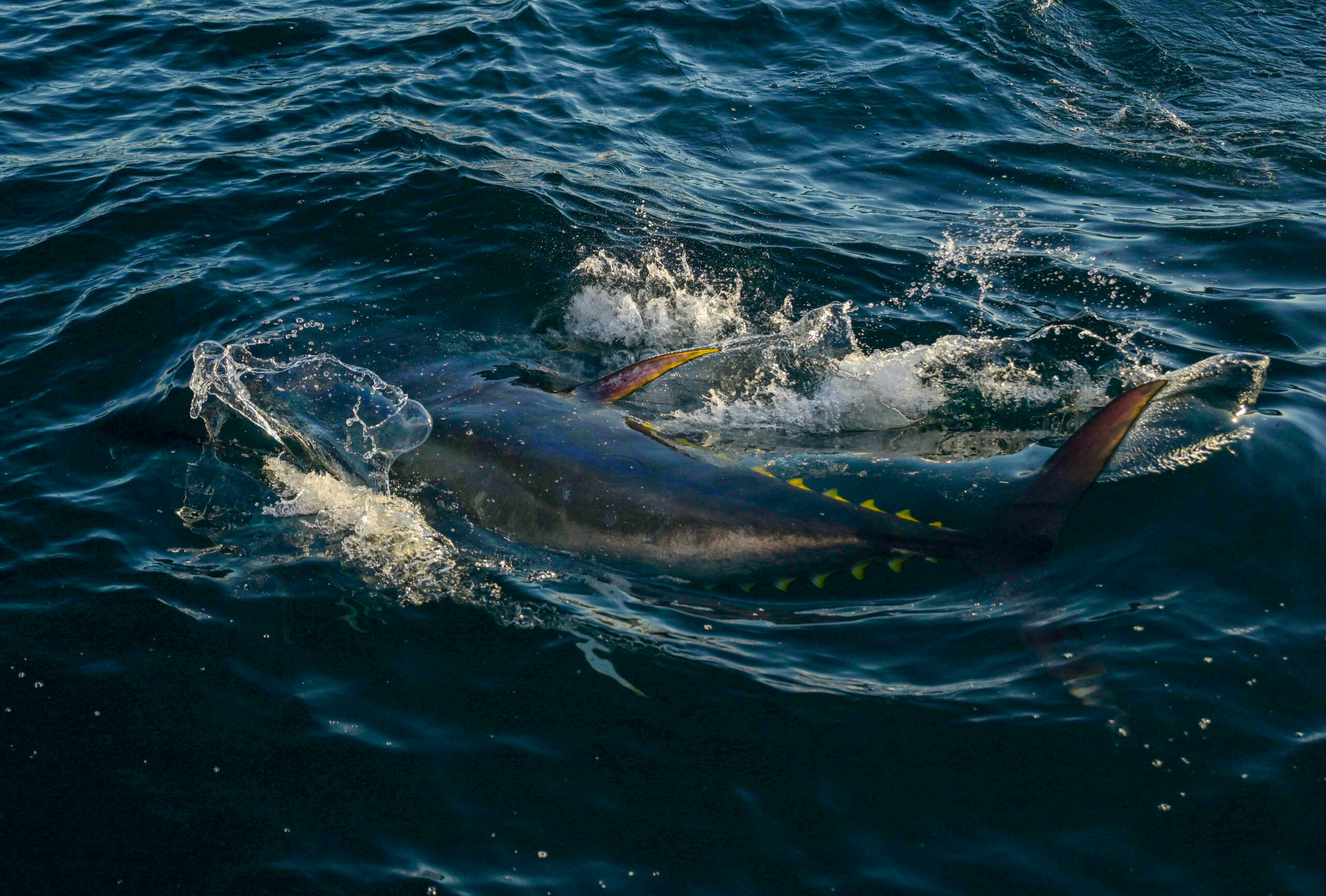
The first hookup of the trip happened so fast it barely felt real. We’d just started chumming — oily sardines and herring ringing the dinner bell — when shadows the size of appliances appeared beneath the surface.
Three hundred pounds.
Four hundred.
Six, seven hundred and more.
Tuna that made your heartbeat change tempo just by existing.
We fished 130 wides with mostly 400-pound leaders, dropping to 200 when we needed a little finesse to convince a stubborn fish. Even with gear that would look overbuilt anywhere else, these fish made the drag scream like it was suffering. There’s something humbling about cranking down 60 pounds of drag and realizing the tuna hasn’t even acknowledged the effort.
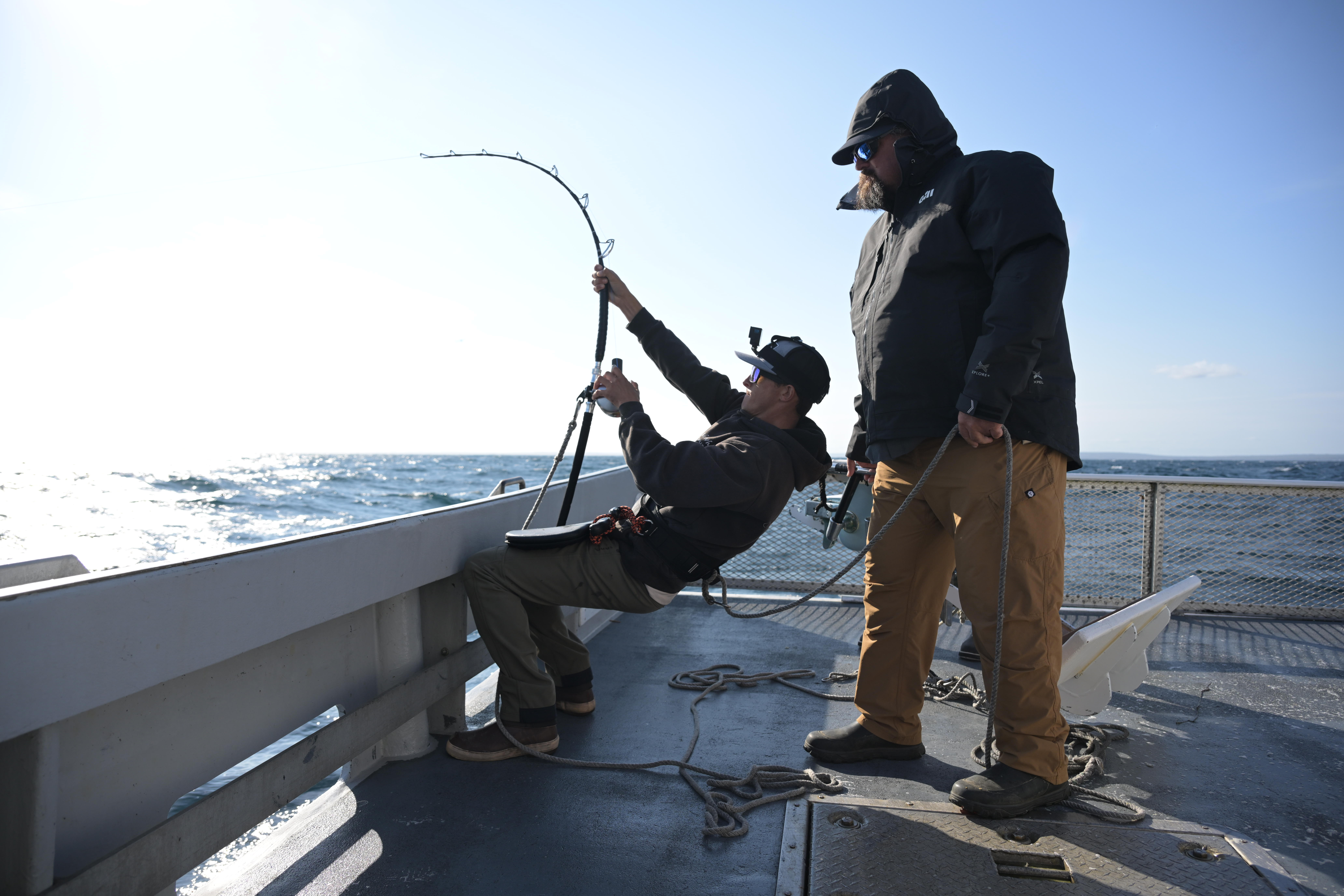
Carter hooked up first.
“There’s a violence to it,” he said later, shaking his head with the ghost of a grin. “Not in a bad way. Just… in a way that reminds you you’re not in control of nearly as much as you think.”
He fought the fish with precision, reading every run, adjusting angles, trusting the boat and the crew. When the leader finally came tight and the fish surfaced beside us — a broad-shouldered slab of living power — the boat went silent for a moment. Not out of shock, but out of respect.
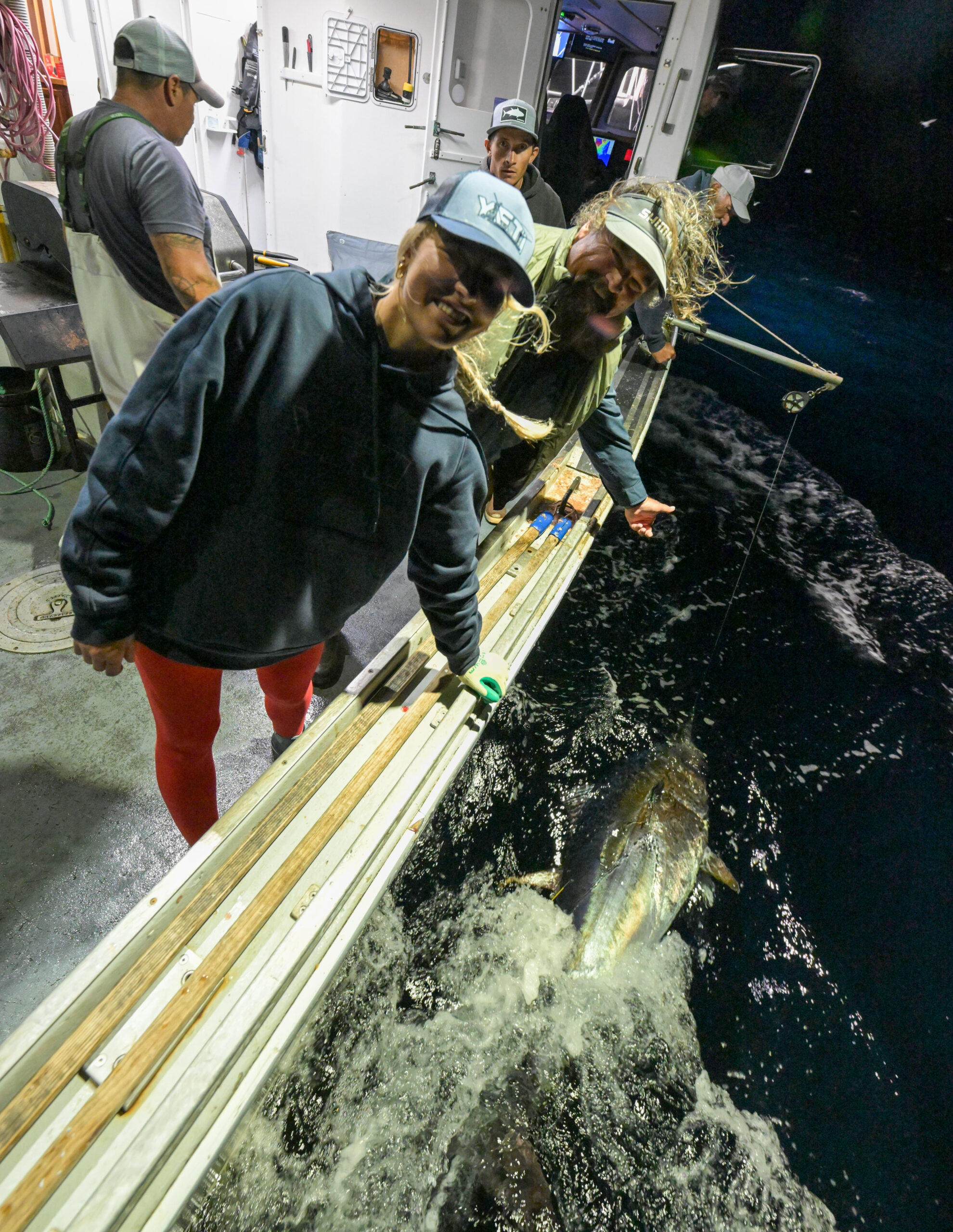
We measured it, logged the data, and inserted a tag. A contribution to science, to the future. A reminder that the pursuit and the preservation can coexist.
Then the fish kicked off, powerful and composed, disappearing into the depths with purpose. That release didn’t feel like an ending.
It felt like a beginning.

EVERY DAY, MORE LESSONS
The pattern repeated each day, but it never once felt repetitive. We’d run a few miles — always with land in sight — set up on promising water, and the fish would come. Some days they ate immediately. Other days we needed to adjust our gear, lighten leaders, or change the chum cadence. There were moments where I swear the tuna were watching us, studying us, deciding if we had earned the right to be there.
We all caught fish. Carter’s daughter fought with a determination that made the crew smile and shake their heads. Carter fished like a surgeon. And I found myself reconnecting with that spark that made me fall in love with fishing in the first place. It’s easy to lose that over time — easy to get lost in deliverables, deadlines, shooting schedules, the pressure to produce. Nova Scotia stripped all that away. Out here, it was just fishing. Just connection.
We tagged fish ranging from the upper 200s to the high 700s, each one an animal you don’t forget. Every battle taught us something, not just about technique, but about ourselves.
SCIENCE & STEWARDSHIP
People see giant bluefin and think of glory — records, measurements, photos, weight estimates. And yes, those things matter in their own way. But when you lean over the rail of a boat in Nova Scotia, tagging a fish that could tow a pickup truck, you start to understand how small you are. You realize that the opportunity to interact with these animals at all is a privilege.
We weren’t here to take from the fishery. We were here to invest in it.
Tagging giant bluefin isn’t just research — it’s a statement. It’s a promise that we’re not just here to enjoy the resource, but to help protect it. There’s no future in a fishery that only takes. There’s a future in balance.
 SLOW-PITCH THERAPY: COD JIGGING
As if the tuna action wasn’t enough, we carved out time for a completely different experience — slow-pitch jigging for cod. It was supposed to be a break, a casual reset between tuna days, but it ended up becoming its own highlight.
The cod were piled up on rock edges and boulder-strewn bottom. Drop a jig, give it life, and wait for the thump. Rods bowed, reels turned, and the boat filled with that happy chaos that only comes from uncomplicated success.
Carter held up a fish at one point and laughed.
“People forget this exists,” he said. “They get so focused on what’s next, or what’s biggest, that they miss how good it feels to just enjoy fishing.”
Fresh cod, cooked the same day, might be the purest expression of why this connection to the ocean matters. It tasted like cold air, clean water, and gratitude.
THE TAKEAWAY
So why Nova Scotia? Why keep coming back?
Because it’s real.
It doesn’t care who you are.
It won’t bend to impress you.
It won’t compromise its identity to fit yours.
Instead, it invites you — quietly — to meet it on its terms.
Fishing here reminded me that our responsibility to the ocean doesn’t end when we coil the lines and stow the rods. Conservation and pursuit are not opposites. They are two halves of a whole, and the future of this fishery depends on people willing to hold both truths at once.
Places like Nova Scotia aren’t guaranteed to remain the way they are. Giant bluefin still migrate through these waters, and the people here still carry knowledge worth listening to. Supporting that matters. Respecting that matters.
For me, that’s reason enough to come back.
For many, it may become a reason to go for the first time.
FINAL THOUGHT
In a world where so much feels curated, filtered, and artificially polished, Nova Scotia feels like the opposite. It feels like truth. Like something worth earning. Like the kind of place that leaves salt on your skin and purpose in your chest.
And as long as these giants continue cutting through these currents, the journey north will always be worth it.