

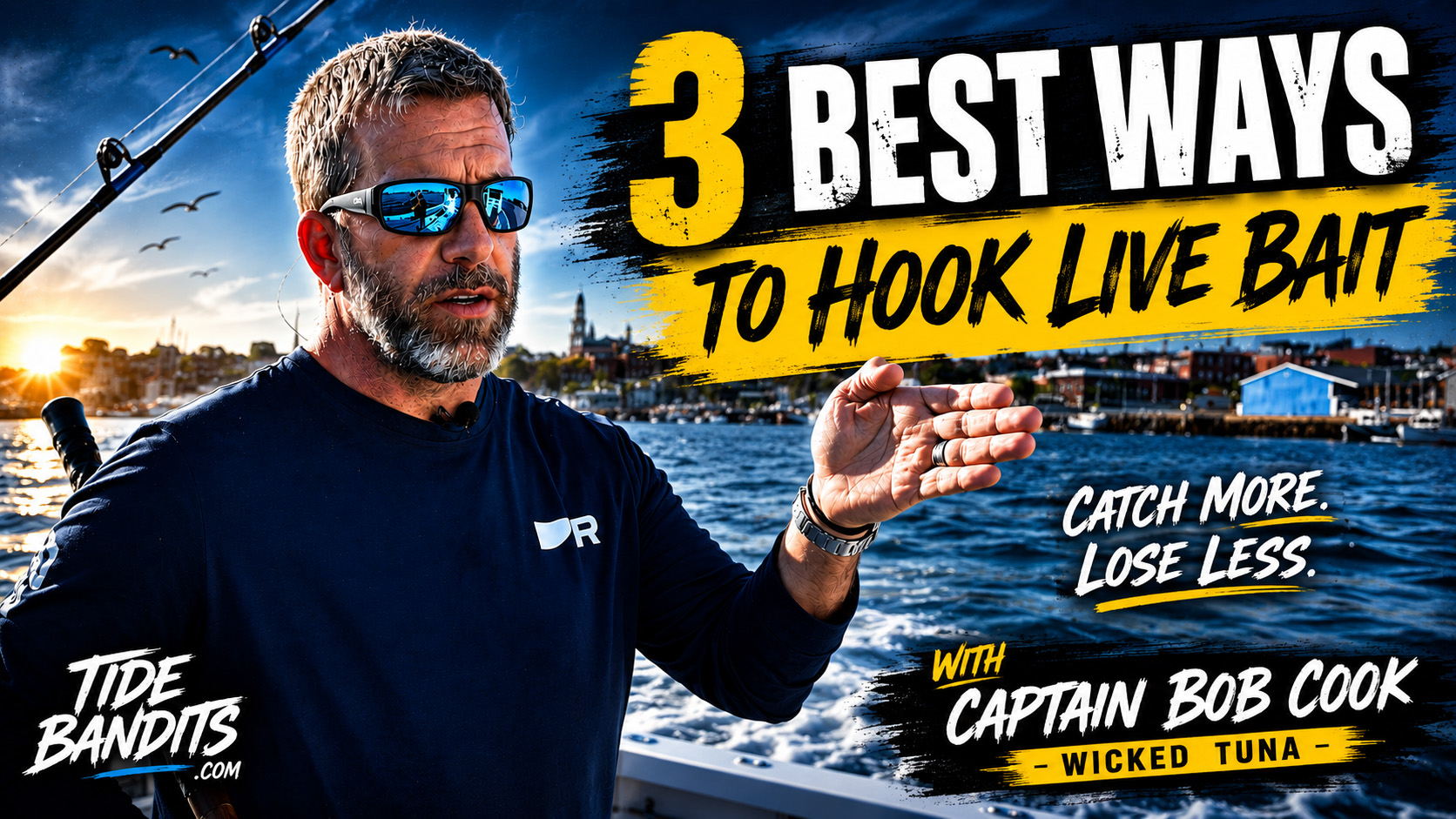
Captain Bob Cook’s Three Proven Ways to Hook Live Bait
Some of the biggest lessons in fishing don’t come from a tackle shop or a YouTube rabbit hole. They come from standing on the deck beside someone who’s spent decades chasing fish for a living. You watch how they move, how they rig a bait, how they study the water, and before long you realize something—the little details are never little. Every decision has a purpose, and those tiny adjustments are often what separate a day full of stories from a day full of excuses.
Captain Bob Cook is one of those fishermen. As captain of the F/V Fat Tuna and a familiar face from Wicked Tuna, he’s spent a lifetime hunting giant Atlantic bluefin tuna and striped bass off the rugged New England coast. Thousands of days on the water have taught him that success isn’t built on gimmicks or secret spots. It’s built on experience, observation, and understanding how predators react to the smallest details. When Bob talks about rigging live bait, he isn’t sharing theories. He’s passing along lessons that have been earned one fish at a time.
One thing becomes clear within the first few moments of watching him explain his process. Everything revolves around presentation.
That’s a word anglers hear all the time, but presentation is much more than making a bait look alive. It’s about convincing one of the ocean’s most efficient predators that what it’s looking at is an easy meal. A bluefin tuna didn’t become an apex predator by making careless decisions. Neither did a mature striped bass. They’ve spent their entire lives hunting schools of baitfish, and they instantly recognize when something doesn’t look natural. A leader hanging awkwardly beneath a bait, a fish swimming at an unnatural angle, or a bait struggling against the pull of the hook can all be enough to make a trophy fish lose interest.
That’s why Captain Bob changes the way he hooks a bait depending on exactly how he wants it to behave.
When he’s bump trolling, his choice is simple. The hook goes through the nostrils. It allows the baitfish to breathe properly while tracking naturally behind the boat as it slips in and out of gear. Instead of fighting the pull of the leader, the bait swims the way nature intended, creating the kind of effortless presentation that predators see every day. It isn’t flashy. It isn’t complicated. It simply looks right, and sometimes that’s all it takes to fool a fish that’s spent years surviving in the open ocean.
Once the boat drops the anchor, however, everything changes. The fish aren’t looking at a bait moving behind the boat anymore. Now they’re inspecting something suspended in the water column, often with plenty of time to study it before deciding whether to commit. That’s when Bob reaches for a different hook placement.
Rather than hooking through the nose, he slips the hook just beneath the skin behind the gill plate. It sounds like a small adjustment, but it completely changes how the bait behaves. Instead of the leader hanging below the fish where it becomes more visible, the bait naturally swims in line with the leader. The entire presentation becomes cleaner, more natural, and far less suspicious. It’s one of those details most anglers would never think twice about, yet it’s exactly the kind of adjustment that can make the difference when you’re trying to fool a giant bluefin that has seen every trick in the book.
Then there’s the third method—hooking the bait near the anal fin. At first glance it almost seems backwards, but there’s a very specific reason Bob uses it. Hooking the bait in this location encourages it to swim downward instead of staying near the surface. When fish are marked deeper on the sonar or suspended beneath balloons, that natural instinct to dive places the bait exactly where it needs to be without relying solely on heavy weights or artificial movement. Rather than forcing the bait into position, the bait does the work itself, and once again, everything appears completely natural to the predator below.
What stands out most isn’t necessarily the three techniques themselves. Plenty of experienced captains have their own variations. What really stands out is Bob’s willingness to adapt. He’s constantly reading the conditions, paying attention to where fish are holding, and changing his presentation to match what the moment demands. Fishing isn’t treated like a routine where the same rig gets tossed overboard trip after trip. It’s a constant conversation between the angler and the ocean, and the fish usually tell you exactly what they want—if you’re willing to pay attention.
That philosophy carries over into the bait itself. Bob believes in matching whatever forage the fish are feeding on, whether it’s Atlantic herring, mackerel, whiting, squid, or another local baitfish. If tuna are feeding on herring, he fishes herring. If squid become the primary forage, he’ll experiment with different hook placements through the mantle, near the head, or around the beak until the presentation looks exactly the way he wants it. Every day is different, and successful fishermen understand that yesterday’s winning pattern may not mean a thing when the sun comes up tomorrow.
It’s a mindset that separates professional captains from anglers who refuse to adjust. Too often fishermen become attached to one technique simply because it worked last weekend or last season. They keep dragging the same bait through the water even when every sign says the fish have changed their behavior. Captain Bob approaches every trip differently. He watches. He experiments. He makes small adjustments throughout the day because he understands that offshore fishing is rarely about finding magic. It’s about solving a puzzle that changes every time you leave the dock.
At Tide Bandits, those are exactly the kinds of conversations we love having. Anyone can tell you where to stick a hook. The valuable part is understanding why. That’s the kind of knowledge that only comes from decades on the water chasing fish that expose every weakness in your presentation. It’s the difference between memorizing a technique and truly understanding it.
The next time you’re reaching into the livewell before sunrise, slow down for a second. Think about where the fish are holding. Think about how you want your bait to move through the water. Ask yourself what the predator is going to see long before it ever reaches your hook. Then rig your bait with purpose instead of habit.
Because in offshore fishing, success usually isn’t determined by the biggest boat, the newest electronics, or the most expensive rod. More often than not, it’s earned through dozens of small decisions that add up over the course of a day. And sometimes, the decision that matters most is nothing more than where you place the hook.
Want to take your fishing to the next level? There’s no substitute for time on the water with someone who’s spent a lifetime chasing giant bluefin tuna and trophy striped bass. If you’re serious about becoming a better angler, book a charter with legendary Captain Bob Cook aboard the F/V Fat Tuna. With decades of experience, five seasons on Wicked Tuna, and countless trophy fish to his credit, Captain Bob doesn’t just put clients on fish—he teaches the techniques and decision-making that have made him one of the most respected captains in the Northeast.
To learn more or book your next adventure, visit Fat Tuna Charters and experience world-class striped bass and giant bluefin tuna fishing with one of the best in the business. Tight lines—we’ll see you on the water.